Development of Federated Blockchain-IoT Public Health Network with Privacy-Preserving Analytics
Keywords:
Federated Learning, Blockchain, IoT Healthcare, Privacy Preservation, Cross-Chain Interoperability, Epidemic Response, Secure Aggregation, Sharding, Network SecurityAbstract
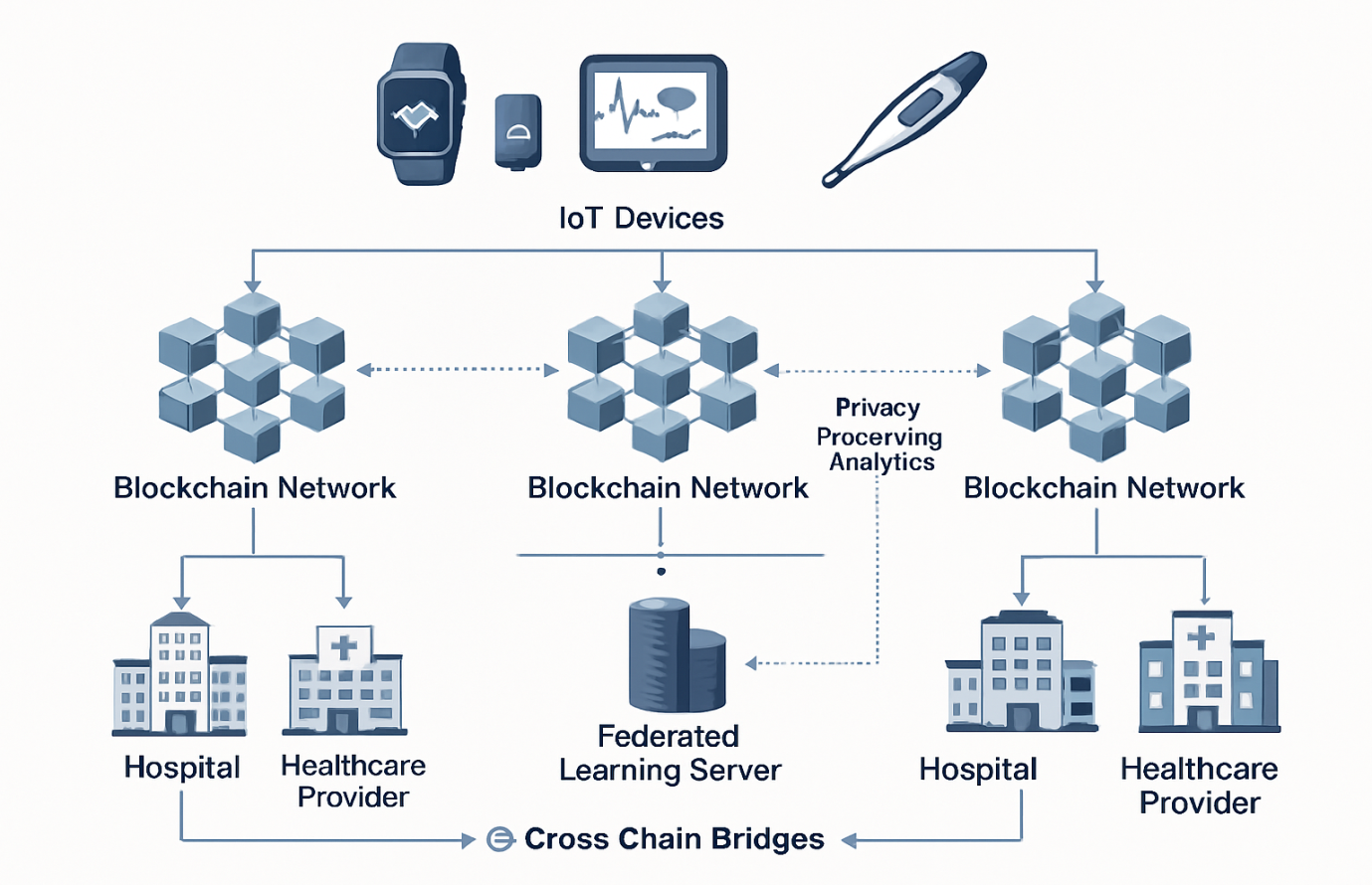
The rapid expansion of Internet of Things (IoT) devices in healthcare has caused concerns around data privacy, interoperability, and system scalability. Conventional centralized data processing models expose sensitive patient information to security vulnerabilities and hinder collaborative analytics across healthcare institutions. To address these challenges, this paper proposes a novel Federated Blockchain-IoT Public Health Network that combines privacy-preserving federated learning with permissioned blockchain technology and cross-chain atomic swap protocols. This integration enables secure, efficient, and interoperable healthcare data analytics in a distributed environment. The framework employs homomorphic encryption and secure aggregation to protect patient data privacy while allowing collaborative model training on decentralized healthcare nodes
References
[1] Y. Zuo, "Exploring the synergy: AI enhancing blockchain, blockchain empowering AI, and their convergence across IoT applications and beyond," IEEE Internet of Things Journal, 2024.
[2] A. H. Allam, I. Gomaa, H. H. Zayed, and M. Taha, "IoT-based eHealth using blockchain technology: a survey," Cluster Computing, vol. 27, no. 6, pp. 7083–7110, 2024.
[3] E. K. Andana, O. A. Y. Ludji, and E. Sumarya, "Blockchain-Enabled Framework for Securing IoT Data Transactions," The Journal of Academic Science, vol. 2, no. 3, pp. 995–1007, 2025.
[4] N. Choi and H. Kim, "Technological Convergence of Blockchain and Artificial Intelligence: A Review and Challenges," Electronics, vol. 14, no. 1, p. 84, 2024.
[5] H. Ding, W. Cheng, X. Song, G. Dong, X. Cui, W. Yu, and D. I. Wilson, "Integration of Distributed Technologies for Intelligent Food Quality and Safety Management: Blockchain, IoT, and Federated Learning," Food Reviews International, pp. 1–23, 2025.
[6] J. A. M. A. L. Elhachmi and A. Kobbane, "Blockchain-based security mechanisms for internet of medical things (IOMT)," International Journal of Computer Networks & Communications (IJCNC), vol. 14, no. 14, 2022.
[7] A. Denis, A. Thomas, W. Robert, A. Samuel, S. P. Kabiito, Z. Morish, et al., "A Survey on Artificial Intelligence and Blockchain Applications in Cybersecurity for Smart Cities," SHIFRA, pp. 1–45, 2025.
[8] S. Yadav, D. Rathod, M. Singh, and S. Chatterjee, "Blockchain to Unblock the Bio-verse: Implications of Blockchain Technology in Healthcare and Allied Fields," in Beyond Blockchain: Reviewing the Impact and Evolution of Decentralized Networks (Part 1), p. 99, 2025.
[9] Y. I. Alzoubi and A. Aljaafreh, "Blockchain-fog computing integration applications: A systematic review," Cybernetics and Information Technologies, vol. 23, no. 1, pp. 3–37, 2023.
[10] A. Mewada, N. Singh, M. A. Ansari, and A. S. Yadav, Eds., Applications of Blockchain Technology. CRC Press, 2025.
[11] R. Xu, "A Secure-by-Design Federated Microchain Fabric for Internet-of-Things (IoT) Systems," State University of New York at Binghamton, 2023.
[12] J. R. Jim, M. T. Hosain, M. F. Mridha, M. M. Kabir, and J. Shin, "Toward trustworthy metaverse: Advancements and challenges," IEEE Access, vol. 11, pp. 118318–118347, 2023.
[13] K. K. Butt, M. Yousif, I. A. Sumra, A. Qazi, and S. Khan, "Blockchain in the Digital Age: Challenges, Opportunities, and Future Trends," Journal of Computing & Biomedical Informatics, vol. 8, no. 02, 2025.
[14] Y. Yang, M. Lin, Y. Lin, C. Zhang, and C. Wu, "A Survey of Blockchain Applications for Management in Agriculture and Livestock Internet of Things," Future Internet, vol. 17, no. 1, p. 40, 2025.
[15] M. S. Rashed, S. Fakhry, R. Satour, and S. Pathania, "Blockchain Technology in Food Supply Chain Management: Enhancing Traceability, Safety, and Quality," in Food and Industry 5.0: Transforming the Food System for a Sustainable Future, Cham: Springer Nature Switzerland, pp. 427–455, 2025.
[16] B. Siniarski, C. De Alwis, G. Yenduri, T. Huynh-The, G. GÜr, T. R. Gadekallu, and M. Liyanage, "Need of 6G for the metaverse realization," arXiv preprint arXiv:2301.03386, 2022.
[17] M. Attaran, "Blockchain technology in healthcare: Challenges and opportunities," International Journal of Healthcare Management, vol. 15, no. 1, pp. 70–83, 2022.
[18] P. Tagde, S. Tagde, T. Bhattacharya, P. Tagde, H. Chopra, R. Akter, et al., "Blockchain and artificial intelligence technology in e-Health," Environmental Science and Pollution Research, vol. 28, no. 38, pp. 52810–52831, 2021.
[19] IoT Healthcare Security Dataset. (2023). Kaggle. Accessed: Sep. 6, 2025. [Online]. Available: https://www.kaggle.com/datasets/faisalmalik/iot-healthcare-security-dataset
Downloads
Published
Issue
Section
License

This work is licensed under a Creative Commons Attribution-NonCommercial 4.0 International License.
Articles in this journal are licensed under the Creative Commons Attribution-NonCommercial 4.0 International License. This license permits others to copy, distribute, and adapt the work, provided it is for non-commercial purposes, and the original author and source are properly credited.