Dynamic Multi-Objective Framework for Migrating Live Virtual Machines in the Cloud
Keywords:
Cloud Computing, Virtual Machine, VM Migration, Resource Allocation, Resource Utilization, Energy Consumption, Cloud data centers and Hybrid Heuristic Calculation.Abstract
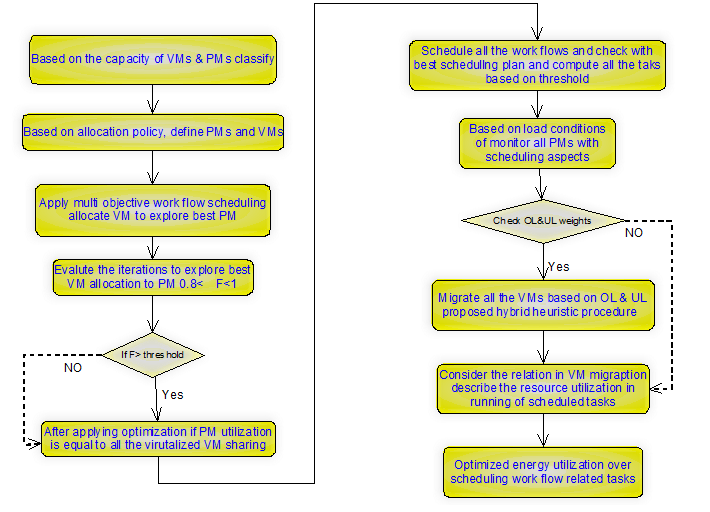
When it comes to data storage environments, cloud computing has been a very promising area of technology. Data centres housing IT (Information Technology) servers are spread out across the world by cloud service providers in response to the high demand for storage and processing power. Efficient energy utilisation for a large number of applications running on separate physical machines is especially challenging in cloud computing environments with a scientific focus, as tasks in resource distribution are dependent on the availability of those resources. The difficult task at hand is to allocate resources more efficiently while simultaneously lowering the energy cost of maintaining data centers, which impacts the quality of service (QoS) of running scientific workflow applications. This research presents a Novel Hybrid Heuristic Framework (NHHF) that uses significant solutions for resource allocation, task scheduling, and scientific workflow optimization through optimized energy utilization. With NHHF, you may migrate virtual machines (VMs) in a multi-objective mechanism that optimizes resource wastage and other parameters, and you can use an Optimized Energy Aware Migration technique to run tasks without dominating the process and reduce energy consumption. Without interfering with or influencing the execution of workflow activities, the multi-objective combinatorial optimization issue is efficiently solved by the suggested innovative hybrid heuristic framework. Energy consumption in data centers is decreased by our proposed approach. Compare the results of the proposed technique's simulation research to those of state-of-the-art technologies, such as distributed dynamic virtual machine management (DDVM), optimized dynamic virtual machine migration approach (ODVMMA), and dynamic voltage frequency scaling (DVFS), using CloudSim
References
[1] Ali Abdullah Hamed Al‑Mahruqi1 • Gordon Morison2 • Brian G. Stewart3 • Vallavaraj Athinarayanan1, "Hybrid Heuristic Algorithm for Better Energy Optimization and Resource Utilization in Cloud Computing", Wireless Personal Communications (2021) 118:43–73 https://doi.org/10.1007/s11277-020-08001-x.
[2] K. Karthikeyan1 • R. Sunder2 • K. Shankar3 • S. K. Lakshmanaprabu4 • V. Vijayakumar5 • Mohamed Elhoseny6 • Gunasekaran Manogaran7, "Energy consumption analysis of Virtual Machine migration in cloud using hybrid swarm optimization (ABC–BA)", The Journal of Supercomputing https://doi.org/10.1007/s11227-018-2583-3.
[3] ABDELHAMEED IBRAHIM , MOSTAFA NOSHY , HESHAM ARAFAT ALI, AND MAHMOUD BADAWY, "PAPSO: A Power-Aware VM Placement Technique Based on Particle Swarm Optimization" Received March 13, 2020, accepted April 16, 2020, date of publication April 30, 2020, date of current version May 14, 2020.
[4] Suruchi Talwani 1, Jimmy Singla, "Enhanced Bee Colony Approach for reducing the energy
consumption during VM migration in cloud computing environment", IOP Conf. Series: Materials Science and Engineering 1022 (2021) 012069 doi:10.1088/1757-899X/1022/1/012069.
[5] Ennio Torre a, Juan J. Durillo a, Vincenzo de Maio b, Prateek Agrawal c,e, Shajulin Benedict d, Nishant Saurabh e, Radu Prodan,"dynamic evolutionary multi-objective virtual machine placement heuristic for cloud data centers", Information and Software Technology 128 (2020) 106390.
[6] Andonovski G, Mušiˇc G, Škrjanc I (2018) Fault detection through evolving fuzzy cloud-based model. IFAC-PapersOnLine 51(2):795–800
[7] Yadav RK, Kushwaha V (2014) An energy preserving and fault tolerant task scheduler in Cloud computing. In: 2014 International Conference on Advances in Engineering and Technology Research (ICAETR), IEEE, pp 1–5
[8] Cerroni W, Esposito F (2016) Optimizing live migration of multiple virtual machines. IEEE Trans Cloud Comput. https://doi.org/10.1109/TCC.2016.2567381
[9] Akram SA, Ghaleb S, Hamaid SB, Vasanthi V (2017) Survey study of virtual machine migration techniques in cloud computing. Migration 177(2):19–22.
[10] SmaraM, AliouatM, Pathan ASK, Aliouat Z (2017) Acceptance test for fault detection in component based cloud computing and systems. Future Gener Comput Syst 70:74–93
[11] Han L, Weili C (2015) Research on fault diagnosis of rolling bearing based on wavelet packet energy feature and planar cloud model. In: 2015 12th IEEE International Conference on Electronic Measurement & Instruments (ICEMI), vol 1. IEEE, pp 36–40
[12] Satpathy A, Addya SK, Turuk AK, Majhi B, Sahoo G (2017) Crow search based virtual machine placement strategy in cloud data centers with live migration. Comput Electr Eng. https://doi.org/10.1016/j.compeleceng.2017.12.032
[13] Qiu X, Dai Y, Xiang Y, Xing L (2017) Correlation modeling and resource optimization for cloud service with fault recovery. IEEE Trans Cloud Comput. https://doi.org/10.1109/TCC.2017.2691323
[14] Wahid F, Kim DH (2016) An efficient approach for energy consumption optimization and management in the residential building using artificial Bee colony and fuzzy logic. Math Probl Eng 2016:1–14
[15] Qasem GM, Madhu BK (2017) Proactive fault tolerance in cloud data centers for performance efficiency. Int J Pure Appl Math 117(22):325–329.
[16] Manojit. G, Verma. P, Karmakar. S ,Sahu. A (2017), Energy efficient scheduling of scientific workflows in cloud environment, IEEE 19th International Conference on High Performance Computing and Communications, IEEE 15th International Conference on Smart City, IEEE 3rd International Conference on Data Science and Systems (HPCC/SmartCity/DSS)., pp.170–177.
[7] Juan. D. J, Nae. V and Prodan. R (2014), Multi-objective energy-efficient workflow scheduling using list-based heuristics, Future Generation Computer Systems., Vol.36, pp.221–236.
[18] Zhaomeng, Z, Zhang, G., Miqing, L., & Liu, X. (2016). Evolutionary multi-objective workflow scheduling in cloud. IEEE Transactions on parallel and distributed Systems, 27(5), 1344–1357.
[19] Rehman, A., Hussain, S. S., ur Rehman, Z., Zia, S., & Shamshirband, S. (2018). Multi-objective approach of energy efficient workflow scheduling in cloud environments. Concurrency and Computation: Practice and Experience., 31(19), 4949.
[20] Li, Z., Ge, J., & Hu.H, Song.W, Hu.H, Luo.B, . (2018). Cost and energy aware scheduling algorithm for scientific workflows with deadline constraint in clouds. IEEE Transactions on Services Computing., 11(4), 713–726.
[21] Choudhary, A., Gupta, I., Singh, V., & Jana, P. K. (2018). A GSA based hybrid algorithm for biobjective workflow scheduling in cloud computing. Future Generation Computer Systems, 83, 14–26.
[22] Garg, R., & Mittal, M. (2019). Reliability and energy efficient workflow scheduling in cloud environment. Cluster Computing., 22, 1283–1297.
[23] Stavrinides, G. L., & Karatza, H. D. (2019). An energy-efficient, QoS-aware and cost-effective scheduling approach for real-time workflow applications in cloud computing systems utilizing DVFS and approximate computations. Future Generation Computer Systems., 96, 216–226.
[24] Sardaraz, M., & Tahir, M. (2019). A Hybrid Algorithm for Scheduling Scientific Workflows in Cloud Computing. IEEE Access, 7, 186137–186146.
[25] Shirvani, M. H. (2020). A hybrid meta-heuristic algorithm for scientific workflow scheduling in heterogeneous distributed computing systems. Engineering Applications of Artificial Intelligence, 90, 103501.
[26] Gu, Y., & Budati, C. (2020). Energy-aware workflow scheduling and optimization in clouds using bat algorithm. Future Generation Computer Systems, 113, 106–112.
[27] Adhikari, M., Amgoth, T., & Srirama, S. N. (2020). Multi-objective scheduling strategy for scientific workflows in cloud environment: A firefly-based approach”. Applied Soft Computing, 10, 106411.
[28] R. Yadav, W. Zhang, O. Kaiwartya, P. R. Singh, I. A. Elgendy, and Y. Tian, ``Adaptive energy-aware algorithms for minimizing energy consumption and sla violation in cloud computing,'' IEEE Access, vol. 6, pp. 5592355936, 2018.
[29] R. Yadav and W. Zhang, ``MeReg: Managing energy-SLA tradeoff for green mobile cloud computing,'' Wireless Commun. Mobile Comput., vol. 2017, Dec. 2017, Art. no. 6741972.
[30] R. Nasim, J. Taheri, and A. J. Kassler, ``Optimizing virtual machine consolidation in virtualized datacenters using resource sensitivity,'' in Proc. IEEE Int. Conf. Cloud Comput. Technol. Sci. (CloudCom), Dec. 2016,pp. 168175.
[31] A. Marcel, P. Cristian, P. Eugen, P. Claudia, T. Cioara, I. Anghel, and S. Ioan, ``Thermal aware workload consolidation in cloud data centers,'' in Proc. IEEE 12th Int. Conf. Intell. Comput. Commun. Process. (ICCP), Sep. 2016, pp. 377384.
[32] F. Farahnakian, R. Bahsoon, P. Liljeberg, and T. Pahikkala, ``Self-adaptive resource management system in IaaS clouds,'' in Proc. IEEE 9th Int. Conf. Cloud Comput. (CLOUD), Jun. 2016, pp. 553560.
[33] S.-Y. Hsieh, C.-S. Liu, R. Buyya, and A. Y. Zomaya, ``Utilizationprediction- aware virtual machine consolidation approach for energy efficient cloud data centers,'' J. Parallel Distrib. Comput., vol. 139, pp. 99109, May 2020.
[34] A. Abdelsamea, A. A. El-Moursy, E. E. Hemayed, and H. Eldeeb, ``Virtual machine consolidation enhancement using hybrid regression algorithms,'' Egyptian Informat. J., vol. 18, no. 3, pp. 161170, Nov. 2017.
[35] L. Xie, S. Chen, W. Shen, and H. Miao, ``A novel self-adaptive VM consolidation strategy using dynamic multi-thresholds in IaaS clouds,'' Future Internet, vol. 10, no. 6, p. 52, 2018.
[36] A. Mosa and R. Sakellariou, ``Virtual machine consolidation for cloud data centers using parameter-based adaptive allocation,'' in Proc. 5th Eur. Conf. Eng. Computer-Based Syst. - ECBS, New York, NY, USA, 2017, p. 16.
[37] D. A. Alboaneen, B. Pranggono, and H. Tianeld, ``Energy-aware virtual machine consolidation for cloud data centers,'' in Proc. IEEE/ACM 7th Int. Conf. Utility Cloud Comput., Washington, DC, USA, Dec. 2014, pp. 10101015.
[38] Y. Chang, C. Gu, F. Luo, G. Fan, and W. Fu, ``Energy efcient resource selection and allocation strategy for virtual machine consolidation in cloud datacenters,'' IEICE Trans. Inf. Syst., vol. E101.D, no. 7, pp. 18161827, Jul. 2018.
[39] R. Yadav, W. Zhang, H. Chen, and T. Guo, ``MuMs: Energy-aware VM selection scheme for cloud data center,'' in Proc. 28th Int. Workshop Database Expert Syst. Appl. (DEXA), Aug. 2017, pp. 132136.
[40] R.Yadav,W. Zhang, K. Li, C. Liu, M. Shaq, and N. K. Karn, ``An adaptive heuristic for managing energy consumption and overloaded hosts in a cloud data center,'' Wireless Netw., vol. 26, no. 3, pp. 19051919, Apr. 2020.
[41] M. A. H. Monil and R. M. Rahman, ``VM consolidation approach based on heuristics, fuzzy logic, and migration control,'' J. Cloud Comput., vol. 5, no. 1, p. 8, Dec. 2016.
[42] E. Feller, L. Rilling, and C. Morin, ``Energy-aware ant colony based workload placement in clouds,'' in Proc. IEEE/ACM 12th Int. Conf. Grid Comput., Washington, DC, USA, Sep. 2011, pp. 2633.
[43] M.-H. Malekloo, N. Kara, and M. El Barachi, ``An energy efficient and SLA compliant approach for resource allocation and consolidation in cloud computing environments,'' Sustain. Comput., Informat. Syst., vol. 17,pp. 924, Mar. 2018.
[44] F. Farahnakian, T. Pahikkala, P. Liljeberg, J. Plosila, N. T. Hieu, and H. Tenhunen, ``Energy-awareVMconsolidation in cloud data centers using utilization prediction model,'' IEEE Trans. Cloud Comput., vol. 7, no. 2, pp. 524536, Apr. 2019.
[45] Thummuluru Kavitha, Dr.Thatimakula Sudha “EFFICIENT RESOURCE UTILIZATION APPROACH IN CLOUD COMPUTING USING OPTIMIZED DIRECT RESOURCE PROVISIONING” “The Seybold Report” Vol 18, No 08 (2023) ISSN 1533-9211 DOI: 10.5281/zenodo.8310627Pgno:1372-1388|Scopus Journal Aug 2023.
[46] Thummuluru Kavitha, Dr.Thatimakula Sudha “NewEdge Machine Learning Approach to Distributed Cloud Workload Forecasting and Resource Provisioning” in International Journal of Communication Networks and Information Security, 16(S1) ISSN: 2073-607X,2076-0930 https://ijcnis.org Scopus Journal Dec 2023.
Downloads
Published
Issue
Section
License

This work is licensed under a Creative Commons Attribution-NonCommercial 4.0 International License.
Articles in this journal are licensed under the Creative Commons Attribution-NonCommercial 4.0 International License. This license permits others to copy, distribute, and adapt the work, provided it is for non-commercial purposes, and the original author and source are properly credited.